High-density food liquids
Drinking water, milk, wine… although each one of these nutritive liquids has their own characteristics and specific requirements when it comes to transporting them, there are some foods that are distinguished by their density, which can sometimes vary.
One milk derivative that has a higher density is cream. Transporting this product also requires special temperature conditions, where our isothermal tankers become an essential tool for the journey, which must have minimal temperature fluctuations from origin to destination.
Although cream does not have the same requirements as raw milk—which is particularly susceptible to bacterial growth—it is nonetheless a dairy product that must be transported at low temperatures to ensure its preservation.
Olive oil is another food liquid with distinctive density properties, directly related to its temperature: its density decreases as its temperature rises. In other words, the colder the oil is when loaded, the greater its density; consequently, it is common practice to load it at a specific temperature to facilitate the flow of the liquid, whilst always ensuring that temperature limits are adhered to so as notto alter its properties.
Glucose is the example of the highest density that concerns us here. It is, in fact, a viscousfood liquid . It is frequently used in the manufacture of a wide range of foods such as sweets, confectionery, chocolates, ice cream, industrial bakery products, jams, soft drinks, sauces and ready-made mixes.
Just like oil, the viscosity of glucose varies with temperature, and depending on the type of glucose and its intended use, the temperature range can be from 15°C to 60°C. If the temperature were too low, the product could crystallise, making it difficult to handle. Conversely, if the temperature were too high, there would be a risk that the product could darken and its organoleptic properties could be altered.
Of course, thanks to the thermal insulation of our tankers, the unloading temperature will be practically the same as the loading temperature, so no heating or cooling processes are required during transport.
Another factor to bear in mind with high-density food-grade liquids is the pumping system. At Rios Sangiao, we have isothermal tankers fitted with lobe pumps. This type of pump is specifically designed for high-density liquids and provides the necessary flow rates to fully load one of our tankers in just a few minutes.
The internal movement of this type of lobe pump ensures the liquid is transported smoothly, without pulsations or gurgling. Furthermore, the materials used in their construction – predominantly aluminium and steel – are suitable for contact with food.
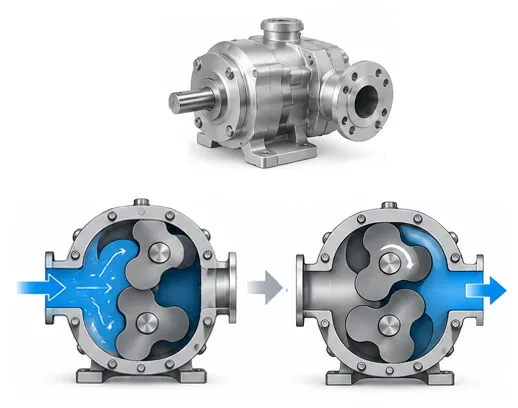
As with the rest of the tank, cleaning of these parts is carried out during every wash cycle of the unit, ensuring that no traces of food or previous tank loads remain.
So, it doesn’t matter whether we have to transport water, milk, wine or food liquids that are no longer quite as liquid as cream, olive oil or glucose because at Rios Sangiao we’re equipped to transport them safely and efficiently.