Although these are essential questions in journalism, they are also essential in traceability, which ultimately ensures a documented, implemented and maintained system that allows any transport service and goods under control to be identified and reconstructed, including mass/quantity balance, in ompliance with IFS Logistics v3 (4.4) and customer requirements.
This traceability applies to all bulk liquid food transport services provided by Rios Sangiao. It includes the management of service documentation (loading orders, CMR/waybill, loading/unloading data, product, quantity, tank/compartment, cleaning and washing certificates, incidents, seals where applicable) and the ability to retrieve, as a minimum, the three previous loads per compartment and the cleaning history, as well as the location of the equipment during the journey via GPS or telephone.
All documentation and records of a service, whether on paper or in electronic format, are fully traceable and allow the service to be reconstructed within a maximum target time of 4 hours, including mass quantity balance, in line with IFS Logistics.
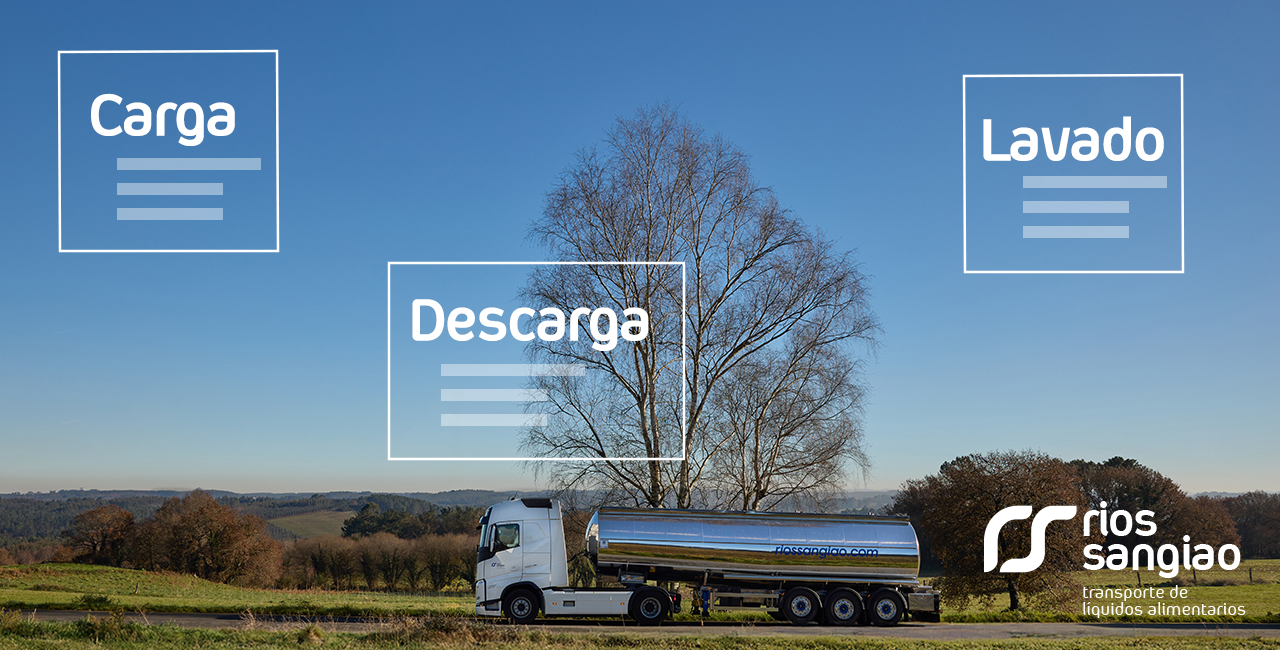
The areas of traceability in which intervention takes place are:
The traceability system is linked not only to the load, but also to the vehicle, establishing a history of journeys, loads, unloads and cleaning of isothermal tanks through certifications at production plants and washing facilities approved by default under EFTCO protocols or, failing that, those determined by the customer for this purpose.
The vehicle traceability file must include at least the following:
At the customer's request, this file may also include records of seals on openings, valves or specific points. The seal number is recorded in the service documentation (e.g. CMR/loading order) and its integrity is verified upon unloading. Locks, valves and hoses are also checked before and after the
operation, and deviations are managed using P-03.
The quantities loaded and unloaded are also recorded. The difference (if any) is analysed taking into account customer criteria and technical factors such as temperature/density, measurement method, permitted losses, etc. When the difference exceeds the agreed criteria or cannot be justified, it is recorded as an incident and managed according to P-03.
Personnel involved in traceability (traffic, administration and drivers) receive training on completing records and specific customer requirements. The Quality Manager reviews the indicators and test results at least annually and implements improvements when necessary.
This gives us greater control over our food liquid transport, allowing us to know where, when, how and why each vehicle is carrying a particular load, and we can pass this information on to the customer for their own quality control purposes.


This has been the work of Sr. Concejo